NHS North West Genomics
0.1.0 - ci-build

NHS North West Genomics
0.1.0 - ci-build
NHS North West Genomics - Local Development build (v0.1.0) built by the FHIR (HL7® FHIR® Standard) Build Tools. See the Directory of published versions
Diagnostic Workflow - MindMap
This implementation guide primarily focuses on the Diagnostic Workflow and how it integrates within the broader health data model, as illustrated in the diagram above.
In software design, these areas are often referred to as domains. The Genomic Diagnostic Workflow operates across several of these domains — in software architecture terms, this is known as a bounded context.
This section of the guide explores the concept of a Domain Archetype — a notion that connects ideas from health informatics, data architecture, and information science with domain-driven design entity models.
To align these perspectives, this guide defines the following relationship:
---
title: Archetype and Entites (Resource)
---
erDiagram
    DomainArchetype ||--|{ DomainEntity : hasMany
    DomainArchetype ||--|{ Archetype : hasMany
    Archetype ||..|| DomainEntity : canBeSame
    DomainEntity }|--|| DomainEvent : ideallyOne
The Domain Archetype concept originates from Data Mesh principles and serves as a bridge between data architecture and software architecture.
A Domain Archetype may encompass multiple Archetypes and Domain Entities. An Archetype and a Domain Entity can represent the same concept. A Domain Event reflects key interactions in Domain-Driven Design; ideally, each archetype or entity should correspond to a single Domain Event, since handling multiple events can lead to architectural anti-patterns - We should use event-driven message feeds rather than relying on batch data transfers (messages) or the physical exchange of compositions.
| Domain Archetype | Archetype | Domain Entity | Domain Event |
|---|---|---|---|
| Laboratory Report | HL7 Lab Results Interface (extends HL7 v2 ORU_R01) | HL7 v2 Segment | HL7 v2 Event Message |
| Laboratory Order and Report | Genomic Reporting - HL7 FHIR Profile | HL7 FHIR Resource | FHIR Workflow |
| Genomic Module - openEHR Archetype |
In genomics, all these archetype definitions are interrelated and designed to be mutually compatible.
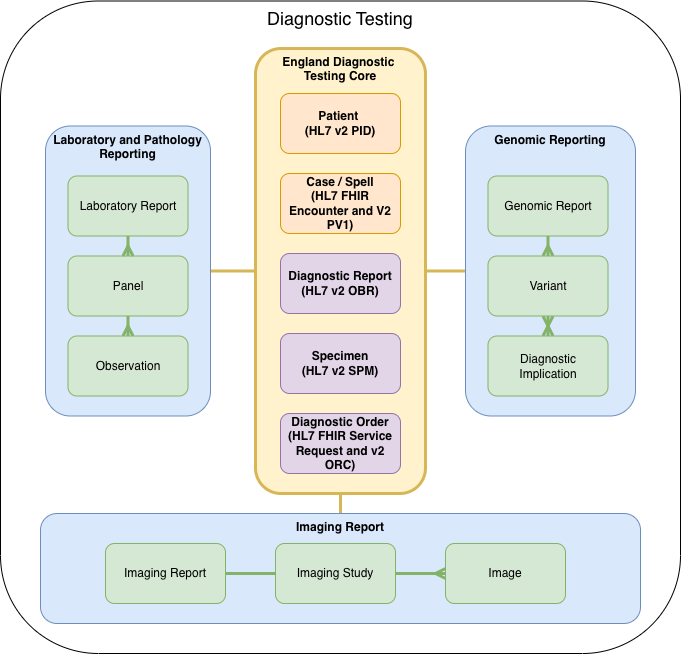
Diagnostic Testing Bounded Contexts
Archetypes High Level Model
This domain focuses on genomic and molecular diagnostics, the data modeling here is Archetypes or templates.
IG © 2024+ NHS North West Genomics. Package fhir.nwgenomics.nhs.uk#0.1.0 based on FHIR 4.0.1. Generated 2025-12-19
Links: Table of Contents |
QA Report
| New Issue | Issues
Version History |
 |
Propose a change
|
Propose a change