
NHS North West Genomics
2.1.4 - ci-build

NHS North West Genomics
2.1.4 - ci-build
NHS North West Genomics - Local Development build (v2.1.4) built by the FHIR (HL7® FHIR® Standard) Build Tools. See the Directory of published versions
Laboratory Report - MindMap
A laboratory report contains both structured and unstructured information, and they complement each other rather than replace one another.
The Laboratory Report acts as the bridge between these two worlds. It references the structured observations for computer processing, clinical decision support, analytics, and interoperability, while also linking to the complete unstructured report that clinicians view as the authoritative laboratory document. This approach ensures that systems can exchange computable data without losing the rich narrative and legal record contained in the original laboratory report.
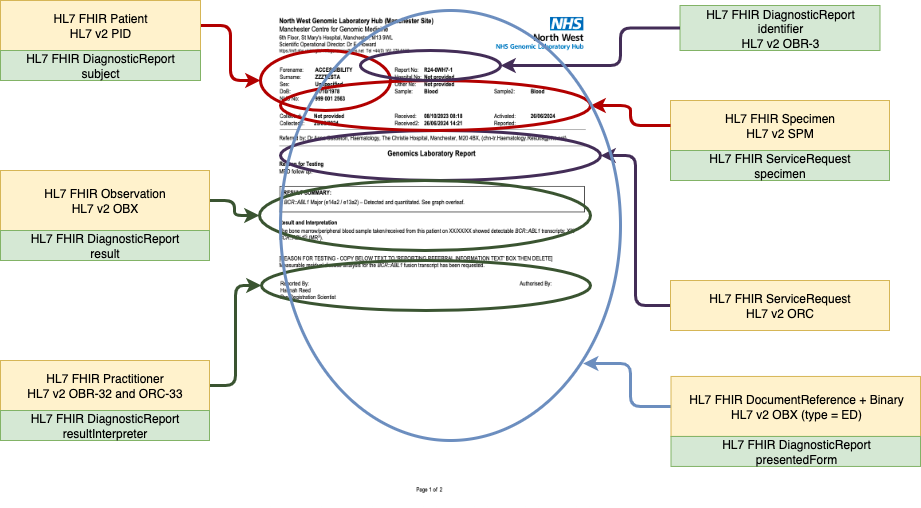
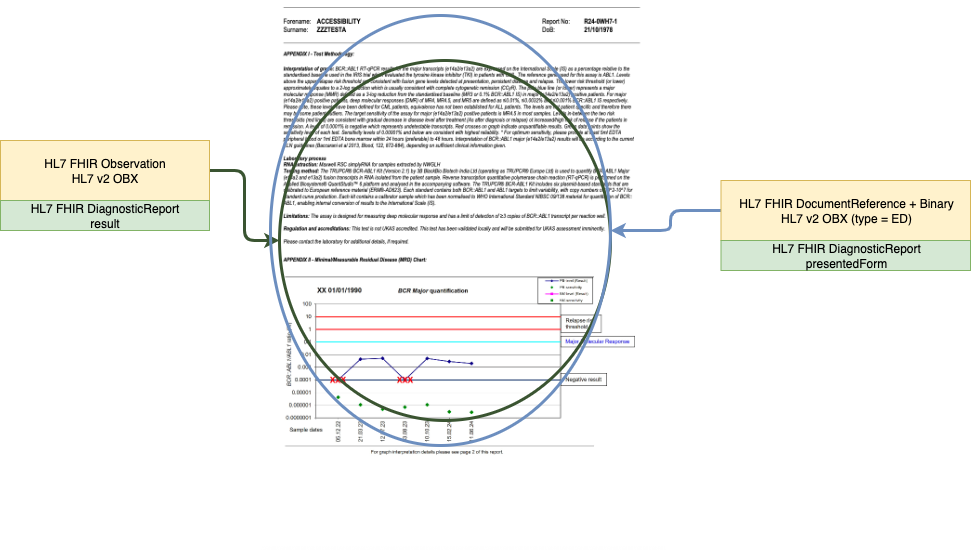
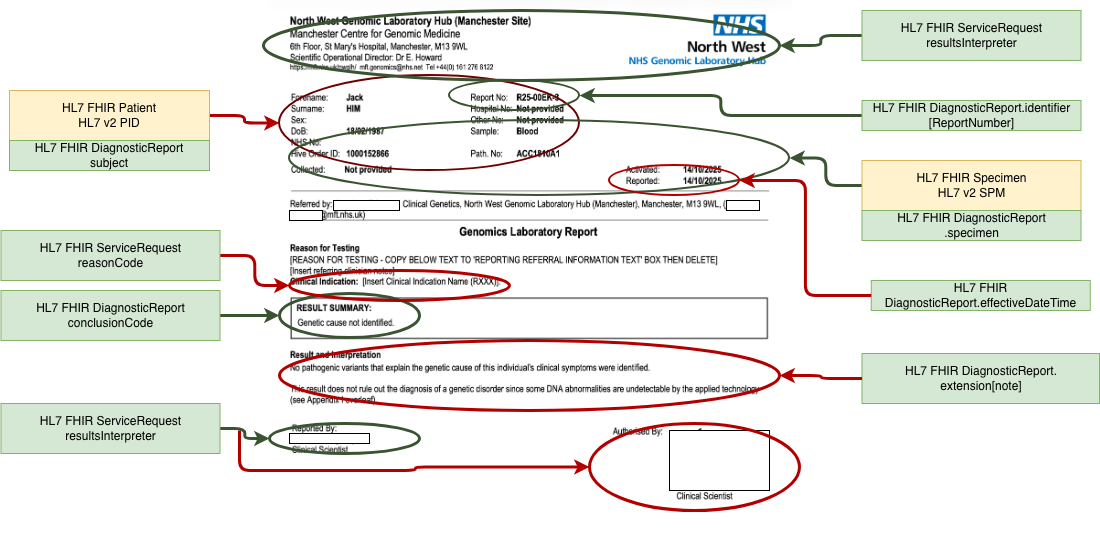
The FHIR DiagnosticReport illustrated above is well suited to workflow-based information exchange, where structured clinical data is exchanged between systems and individual observations can be processed, queried, and acted upon. However, it may be less suitable for document sharing use cases, such as IHE XDS/MHD or the NHS England National Record Locator (NRL), where the laboratory report is exchanged as a complete clinical document. In these scenarios, the preferred approach is a FHIR Document (the FHIR equivalent of a Clinical Document Architecture (CDA) document), which packages the report into a self-contained, attested document with a Composition resource as its root. This preserves the report as a legal and clinical record while still allowing structured data to be included.
Further details are available in the Document Perspective section of the HL7 Europe Laboratory Implementation Guide: HL7 Europe Laboratory Report
NW Genomics example FHIR Document - Genomic Report
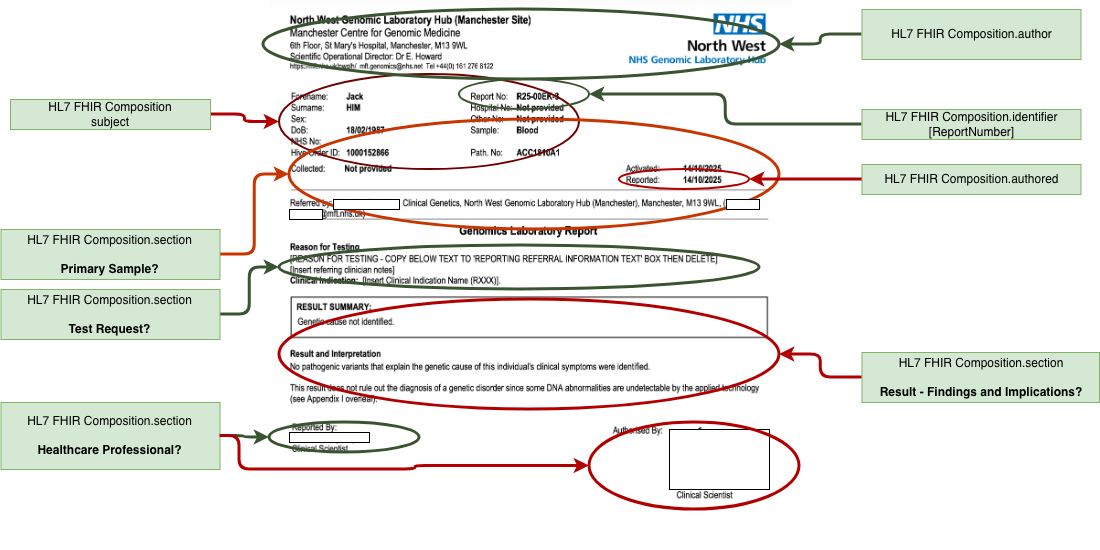
Metadata is data that applies to the patient's entire clinical pathway and so it extends beyond diagnostic tests. Test detail tends to be common across all diagnostic tests in a patient's pathway, not just genomics.
Patient Demographics
| Name | LOINC | Value Set / Data Type | Cardinality | HL7 v2 OML_O21 Message | HL7 FHIR ServiceRequest | HL7 FHIR Resource (Message + RESTful) |
|---|---|---|---|---|---|---|
| NHS Number | NHS Number | 0..1 | PID | ServiceRequest.subject.identifier | Patient | |
| Medical Record Number | Medical Record Number | 0..1 | PID | ServiceRequest.subject.identifier | Patient |
Hospital Spell
Treat as mandatory for reflex or subcontracted orders.
| Name | LOINC | Value Set / Data Type | Cardinality | HL7 v2 OML_O21 Message | HL7 FHIR ServiceRequest | HL7 FHIR Resource (Message + RESTful) |
|---|---|---|---|---|---|---|
| Hospital Service | Service | 0..1 | PV1-10 | Encounter.serviceType | ||
| Case Identification or Account Number | 56797-4 | HospitalProviderSpellIdentifier | 0..1 | PV1-19 | ServiceRequest.encounter.identifier | Encounter.identifier HospitalSpell |
Diagnostic Workflow
| Name | Description | Value Set / Data Type | Cardinality | HL7 v2 ORU_RO1 Message | HL7 FHIR DiagnosticReport | HL7 FHIR Resource (RESTful) |
|---|---|---|---|---|---|---|
| Order Number | The Unique order number assigned by the Order Placer (order comms or EHR), that requested the report. | Order Identifier | 1..1 | ORC-2 | DiagnosticReport.basedOn | ServiceRequest |
| Report Number | Identifies the report, assigned by Order Filler (LIMS) | Report Identifier | 1..1 | OBR-3 | DiagnosticReport.identifier[ReportNumber] | |
| (Order) Procedure Code | For Genomics this is Test Directory Code. (For Radiology this is NICIP code) | See below | 1..1 | OBR-4 | [DiagnosticReport.code | |
| Account(/Visit) Number | Assigned by the Order Placer where it is known as spell or episode id. It is used by all diagnostics to link tests to a spell/episode | Hospital Provider Spell Identifier | PV1-19 | DiagnosticReport.encounter | ||
| Report date | Date/time the report was issued | 1..1 | OBR-7 | DiagnosticReport.effectiveDateTime | ||
| Report Status | 1..1 | OBR-22 | DiagnosticReport.status | |||
| Conclusion | Conclusion | DiagnosticReport.conclusion | ||||
| Outcome | Conclusion Code | DiagnosticReport.conclusionCode | ||||
| Results Interpreter | Who created the report | England Practitioner Identifier | 0..* | OBR-32 and OBR-33 | DiagnosticReport.resultsInterpreter | Practitioner |
| Performer (operator) | England Practitioner Identifier | 1..* | OBR-34 | DiagnosticReport.performer[operator] | Practitioner | |
| Performer (organisation) | The organisation who created the report | Organisation Code | 1..* | DiagnosticReport.performer[organization] | Organizaton | |
| Specimen | The sample(s) that were used for testing | See Genomic Test Order - Specimen | 0..1 | SPM | DiagnosticReport.specimen.identifier | Specimen |
| Results | Detailed (strucutured) results | Domain specific - see below | 0..* | OBX | DiagnosticReport.results | Varies |
| Narrative Report | Results and entire Report in PDF representation | Domain specific - see below | 0..* | OBX (type=ED) | DiagnosticReport.presentedForm |
Results section is specific to genomics and is focused on the requirements of general clinicians, not genomic specialists. For this reason this section will tend to be an extract of the wider genomics reporting specifications.
classDiagram
    class GenomicReport["Genomic Laboratory Report (result)"]
    class Variant
    class GenomicStudy["Genomic Study"]
    class DiagnosticImplication["Diagnostic Implication"]
    class TherapeuticImplication["Therapeutic Implication"]
    class GenomicStudyAnalysis["Genomic Study Analysis"]

    Variant --|> GenomicReport
    GenomicStudy --|> GenomicReport
    GenomicStudyAnalysis --|> GenomicReport
    DiagnosticImplication --|> GenomicReport
    TherapeuticImplication ..|> GenomicReport
    Variant <|--|> DiagnosticImplication
    Variant <|..|> TherapeuticImplication
A more detailed mapping of the results section of the laboratory report, see Genomics Reporting Implementation Guide
| Name | LOINC | Value Set / Data Type | Example | Cardinality | HL7 v2 ORU_RO1 Message | HL7 v2 OBX-4 | HL7 FHIR Resource (RESTful) |
|---|---|---|---|---|---|---|---|
| Narrative Report | 51969-4 | 1..1 | OBX (type=ED) | 1 | DiagnosticReport.presentedForm Attachment and Binary | ||
| Gene studied [ID] | 48018-6 | ACAD9 | 0..1 | OBX | 1.a | Observation Profile Variant.component:gene-studied |
Description: Genomic Study
TBC - This includes Gene studied [ID] (48018-6) and Gene mutations tested (36908-2). Maybe a requirement from oncology. This appears to be part of FHIR R6 GenomicStudy
| Name | LOINC | Value Set / Data Type | Example | Cardinality | HL7 v2 OBX-4 | FHIR Observation Profile |
|---|---|---|---|---|---|---|
| regions | Genomic Study Analysis .extension[regions] | |||||
| Genomic source class [Type] | 48002-0 | Genetic variant source | Somatic | 0..1 | Genomic Study Analysis.extension[genomic-source-class] | |
| specimen | Genomic Study Analysis.extension[specimen] |
Description: Genomic Implications
HL7 LRI (Ref A) Example 2 (5.9.1.2) - FOUND DISCRETE – TARGETED MUTATIONS ANALYSIS THAT STUDIES MANY MUTATIONS (106)
HL7 LRI (Ref A) Example 3 (5.9.1.3) - SIMPLE VARIANT – MUTATION ANALYSIS WITH SEQUENCE PLUS DELETION-DUPLICATION STUDY