
NHS North West Genomics
2.2.0 - ci-build

NHS North West Genomics
2.2.0 - ci-build
NHS North West Genomics - Local Development build (v2.2.0) built by the FHIR (HL7® FHIR® Standard) Build Tools. See the Directory of published versions
| Official URL: https://fhir.nwgenomics.nhs.uk/Questionnaire/GenomicTestOrder | Version: 2.2.0 | ||||
| Active as of 2026-09-20 | Computable Name: | ||||
The aim of this is to support conversion of multiple Genomic Order Forms from several NHS Trusts to HL7 v2 and/or FHIR.
This is the common core order form: the Patient, Healthcare Professional, Test Request and Specimen fields shared by every order, regardless of test type - these map onto the standardised HL7 v2 OML_O21 message and its FHIR equivalent, the FHIR Message O21. Ask At Order Entry questions, which vary by order/test type, are not part of this core form - see Order Entry Questions below for the separate, order-type-specific Questionnaire to use alongside this one.
This Questionnaire describes the common requirement for a Genomic Order,
which is now extended by Ask At Order Entry Questionnaires. Which set of
these extension questionnaires is used depends on the order/test type
(ServiceRequest.code) - see Order Entry Questions
below.
Although this Questionnaire is genomics-specific in name, the model it describes - Patient, Hospital Spell, Diagnostic Workflow and Specimen - is a core model for diagnostic orders generally, not something unique to genomics. The same shape applies equally to pathology, radiology and clinical referral orders; genomics is simply the domain this IG documents it against first. See Diagnostic Model Overview for the basic model this Questionnaire adds detail to, and how it relates to Genomic Test Report on the report side.
This is a level 2 (field-level) view of the basic model introduced in Diagnostic Model Overview, showing the entities and key attributes a Genomic Test Order actually carries:
erDiagram
    Patient ||--|{ ServiceRequest : subject
    HospitalSpell ||--o{ ServiceRequest : encounter
    ServiceRequest ||--o{ Specimen : specimen
    ServiceRequest }o--|| PractitionerRole : requester
    PractitionerRole }o--|| Organization : organization
    ServiceRequest }o--o{ Condition : reasonCode
    ServiceRequest ||--o{ Observation : supportingInfo

    Patient {
        Identifier nhsNumber
        Identifier medicalRecordNumber
        date birthDate
        string postalCode
    }

    HospitalSpell {
        Identifier hospitalProviderSpellIdentifier
        code serviceType
    }

    ServiceRequest {
        Identifier orderIdentifier "Placer"
        Identifier orderFillerNumber "Filler"
        Identifier orderGroupNumber
        code code "Procedure/Test Code"
        dateTime authoredOn
        string note "Clinical Details"
    }

    PractitionerRole {
        Identifier practitionerIdentifier "Ordering Practitioner"
    }

    Organization {
        Identifier organisationCode "Ordering Facility"
    }

    Specimen {
        Identifier specimenId
        CodeableConcept type
        CodeableConcept bodySite
        Identifier accessionIdentifier
        Identifier shipmentTrackingNumber
        dateTime collectedDateTime
        dateTime receivedTime
    }

    Condition {
        CodeableConcept code "Suspected Condition"
    }
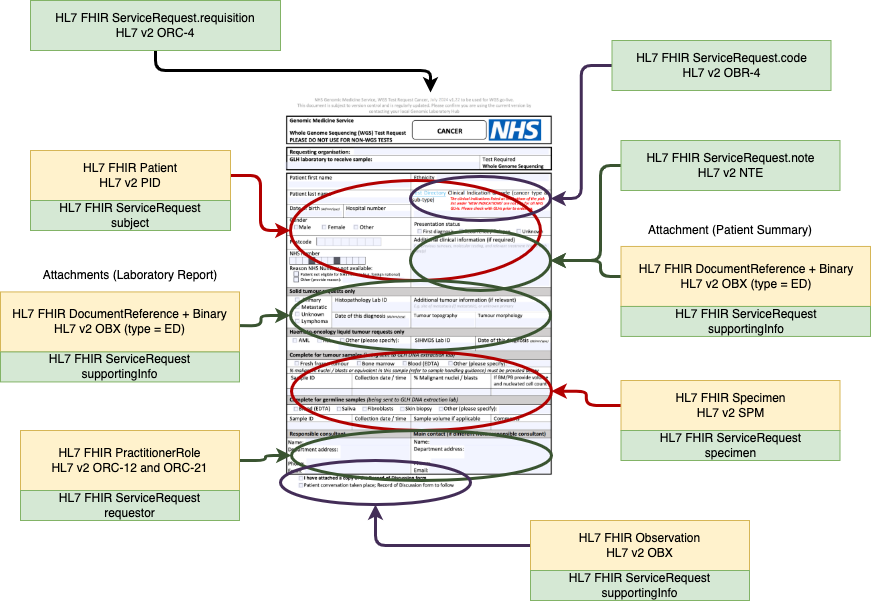
Order Test Form - Data Extraction Overview
FHIR Message, following the laboratory-order message definition, is the primary format for order messages. HL7 v2 OML_O21 Laboratory Order is also supported - the FHIR Message definition is deliberately based on OML_O21's own structure, which simplifies conversion to/from pipe+hat (v2) and json (FHIR) formats.
At present, the NW GLH Laboratory Information Management System (LIMS) will not support HL7 FHIR. The Regional Integration Exchange (RIE) will perform conversion between v2 and FHIR formats.
This message is an aggregate (DDD)/archetype and so is a collection of FHIR Resources (similar to v2 segments) which is described in Genomic Test Order.
| Name | Value Set / Data Type | Cardinality | HL7 v2 OML_O21 Message | HL7 FHIR ServiceRequest | HL7 FHIR Resource (Message + RESTful) |
|---|---|---|---|---|---|
| NHS Number | NHS Number | 0..1 | PID-3 | ServiceRequest.subject.identifier | Patient.identifier[nhsNumber] |
| Medical Record Number | Medical Record Number | 0..1 | PID-3 | if NHS Number not present ServiceRequest.subject.identifier | Patient.identifier[MedicalRecordNumber] |
| Date of Birth | Date of Birth | 0..1 | PID-7 | Patient.birthDate | |
| Postcode | Postcode | 0..1 | PID-11 | Patient.address.postalCode |
Treat as mandatory for reflex or subcontracted orders.
| Name | Value Set / Data Type | Cardinality | HL7 v2 OML_O21 Message | HL7 FHIR ServiceRequest | HL7 FHIR Resource (Message + RESTful) |
|---|---|---|---|---|---|
| Hospital Service | Service | 0..1 | PV1-10 | Encounter.serviceType | |
| Case Identification or Account Number | HospitalProviderSpellIdentifier | 0..1 | PV1-19 | ServiceRequest.encounter.identifier | Encounter.identifier HospitalSpell |
| Name | Value Set / Data Type | Cardinality | HL7 v2 OML_O21 Message | HL7 FHIR ServiceRequest |
|---|---|---|---|---|
| Order Identifier (Placer) | Order Identifier | 1..1 | ORC-2 | ServiceRequest.identifier[OrderIdentifier] |
| Filler Order Number | 0..1 | ORC-3 | ServiceRequest.identifier[OrderFillerNumber] | |
| (Placer) Order Group Number | Order Group Number | 0..1 | ORC-4 | ServiceRequest.requisition.identifier |
| (Order) Procedure Code | Diagnostic Domain specific - See below | 1..1 | OBR-4 | ServiceRequest.code |
| Order date | 0..1 | ORC-9 | ServiceRequest.authoredOn | |
| Ordering Practitioner | England Practitioner Identifier | 0..1 | ORC-12 | ServiceRequest.requester[PractitionerRole] |
| Ordering Facility | Organisation Code | 1..1 | ORC-21 | If Order has requesting practitioner ServiceRequest.requester[PractitionerRole] else ServiceRequest.requester[Organization] |
| performer | Organisation Code | 0..1 | implied by destination of message | ServiceRequest.performer |
| Suspected Condition | Domain specific - See below (Generally SNOMED Condition code) | .. | DG1-3 | ServiceRequest.reasonCode |
| Supporting Information | Domain specific - See below | 0..* | OBX | ServiceRequest.supportingInformation |
| Notes | 0..* | NTE | ServiceRequest.note | |
| Specimen | See Specimen below | 0..* | SPM | ServiceRequest.specimen.identifier |
| Name | Value Set / Data Type | Cardinality | HL7 v2 OML_O21 Message | HL7 FHIR ServiceRequest |
|---|---|---|---|---|
| (Order) Procedure Code - Genomic Test Code | Genomic Test Directory | 1..1 | OBR-4 | ServiceRequest.code |
ServiceRequest may also be split into two logical entities called
OriginalOrder and FillerOrder. The former represents the order received by
the Order Filler from the Order Placer, and the latter is orders the Order
Filler creates to fulfil that order. These are often also called reflex,
work-order or sub-contract orders - both are structurally the same
Genomic Test Order archetype above, just created by a different actor.
flowchart TB
    LO["Laboratory Order<br/>(Original Order)<br/>intent = order / reflex"]
    WO["Work Order<br/>intent = instance-order"]
    SC["Subcontracted Order<br/>intent = filler-order"]
    RO["Reflex Order<br/>intent = reflex"]

    LO -->|"Order Filler creates<br/>(Filler Order)"| WO
    LO -->|"Order Filler creates<br/>(Filler Order)"| SC
    LO -->|"Order Filler creates<br/>(Filler Order)"| RO
One Laboratory Order (the Original Order) can give rise to any of the three
Filler Order shapes in the table below - a Work Order, a Subcontracted
Order, or a Reflex Order - each created by the Order Filler rather than
the original requester, and each carrying its own intent value. See
Diagnostic Model Overview - Linking Related
Orders
for how ServiceRequest.requisition ties a Filler Order back to the
Original Order it descends from.
In IHE Laboratory Testing Workflow, the Original Order is the key entity in LAB-1, and the Filler Order is the key entity in LAB-4 - both share the field-by-field mapping in Diagnostic Workflow above.
| Type | Description | IHE PALM | Created by | Original Order Intent | Filler Order Intent |
|---|---|---|---|---|---|
| Laboratory Order | A request for one or more laboratory investigations submitted by the requesting clinician or system. | LAB-1 | Order Placer | order / reflex | |
| Work Order | A subordinate order created by the laboratory to organise and fulfil part of the overall Laboratory Order. | LAB-4 | Order Filler | instance-order | |
| Subcontracted Order | A laboratory order forwarded to another laboratory for fulfilment, for example when a specialised test is referred to an external provider. | LAB-35 | Order Filler | filler-order | |
| Reflex Order | A new order created automatically by the Order Filler based on previous test results, for example when pathology findings automatically trigger a genomic test. | LAB-35 | Order Filler | reflex |
| Name | LOINC | Value Set / Data Type | Cardinality | HL7 v2 OML_O21 Message | HL7 FHIR Specimen |
|---|---|---|---|---|---|
| Specimen ID | 80398-1 | 0..* | SPM-2 | Specimen.identifier[PlacerSpecimenNumber] | |
| Specimen Type | Specimen Type | 1..1 | SPM-4 | Specimen.type | |
| Specimen Source Site | Specimen Body Site | 0..1 | SPM-8 | Specimen.collection.bodySite | |
| Specimen Accession Number | 80398-1 | Specimen Accession Number | 0..* | SPM-30 | Specimen.accessionIdentifier |
| Shipment Tracking Number | 97209-1 | Shipment Tracking Number | 0..* | SPM-32 | Specimen.identifier[ShipmentTrackingNumber] |
| Specimen Collection Date | 0..1 | SPM-17 | Specimen.collection.collectedDateTime | ||
| Specimen Received Date | 0..1 | SPM-18 | Specimen.receivedTime |
Note: it is likely that source systems will use ORM_01 and not include specimen details. In this case it is suggested that the specimen details are captured as 'Ask at Order Entry Questions' and so provided as OBX segments.
flowchart LR
    CORE["Laboratory Order Core"]
    AAOEC["Ask At Order Entry Questions<br/>Genomic Order Common Questions"]
    AAOET["Genomic Test Specific Additional Ask At<br/>Order Entry Questions (e.g. WGS,<br/>Cancer, Chimerism Testing)"]
    QNAIRE["Order entry form<br/>(EPR / Order Comms system)"]
    MSG["HL7 v2.5.1 OML_O21<br/>or FHIR R4 Message O21"]
    LIMS["LIMS"]

    CORE --> QNAIRE
    AAOEC --> QNAIRE
    AAOET --> QNAIRE
    QNAIRE -->|"order placed"| MSG
    MSG --> LIMS
The common core, plus whichever Ask At Order Entry Questionnaire(s) apply,
together are what a Questionnaire/QuestionnaireResponse represents -
the order entry form as it appears inside an EPR or Order Comms system.
HL7 v2 OML_O21/FHIR Message O21 is a different thing: the wire
format that same order is sent onward to a LIMS in, once it's placed - not a
form a user fills in. Ask At Order Entry questions are what vary between
test types; the message shape they end up populating downstream does not.
Ask At Order Entry Questions generally get transformed to Observation
(OBX) or RelatedPerson (NK1) when added to this HL7 v2/FHIR message,
and are linked in FHIR via ServiceRequest.supportingInfo.
For most order/test types this is two Questionnaires combined - the common core plus one Ask At Order Entry Questionnaire. Some test types split the Ask At Order Entry side further, into questions common to several test types (e.g. Ask At Order Entry Questions Common, shared by Cancer, WGS and Rare and Inherited Disease orders) plus questions specific to just one (e.g. WGS Test Additional Ask At Order Entry Questions) - a WGS order therefore combines three Questionnaires. HLA Tests - Transplant and Chimerism Test Additional Ask At Order Entry Questions sit in the same "Test Specific" tier as WGS, just without a shared "Common" tier of their own today - each combines directly with the common core, the same two-Questionnaire shape as most other test types.
Coding Ask At Order Entry questions. Local coding (against the NWGMSA
CodeSystem) is acceptable where no suitable national code exists, and is
used throughout this IG's own Ask At Order Entry Questionnaires. Where a
national code does exist for an important/key question, using it is
preferred, to aid communication with systems and services beyond this IG -
SNOMED CT or LOINC, whichever actually has a matching concept. In practice
this is more often LOINC than SNOMED CT: SNOMED CT is a clinical
terminology, and doesn't tend to hold codes for questions themselves (as
opposed to the findings/answers a question is about), whereas LOINC's own
question-and-panel structure covers this directly - so LOINC is often the
only coded option available, not a stylistic preference.
The same pattern recurs on the report side: Genomic Test
Report's panels and Genomic Results vary
according to which test is being recorded in the LIMS, in exactly the same way Ask At
Order Entry questions vary by test type here - and HL7 v2 ORU_R01/FHIR Message R01
is, correspondingly, how that varying report content is sent onward from the LIMS to
the EPR, the mirror image of OML_O21/FHIR Message O21 on the order side.
The Questionnaires in this IG are regarded as Domain Archetypes - a term
deliberately borrowed from openEHR,
where an archetype is a formal, reusable model of a clinical/domain concept used to
elaborate a data model during a project's early stages, independent of how it's later
persisted or exchanged. FHIR logical models can serve the same elaboration purpose;
this IG uses Questionnaire/QuestionnaireResponse instead, and the link to
openEHR's own archetype concept is intentional, not coincidental.
These Questionnaires may also represent a persistence standard for some
implementations, but this guide itself is about exchange - either HL7 v2/FHIR
messaging or a FHIR REST API. It is the resources that a completed questionnaire
(e.g. a QuestionnaireResponse) breaks down into - Patient, ServiceRequest,
Observation, RelatedPerson, Specimen, and so on - that are actually used for
data exchange, not the Questionnaire/QuestionnaireResponse itself.
Separately, a Questionnaire may also be used to build the actual data-entry screens
within an EPR or other application - see HL7 FHIR Structured Data
Capture for more on that use.
This Questionnaire (defined below, titled Genomic Test Order in this IG) represents the Laboratory Order Core: the Patient, Healthcare Professional, Test Request and Specimen fields shared by every order, regardless of test type or diagnostic domain - the same shape would apply equally to a pathology or radiology order, not just genomics (see this page's own introduction above) - mapping onto the standardised HL7 v2 OML_O21 message and its FHIR equivalent, the FHIR Message O21.
Ask At Order Entry questions vary by order/test type, so they are not part of the
common core - each order/test type instead uses its own Ask At Order Entry
Questionnaire. Those below derivedFrom/extend this common core Questionnaire; the
NW GLH Paper Test Request Forms further down
don't yet declare that relationship - see that section for why.
These Ask At Order Entry Questionnaires originated within this IG, modelling an existing digital order-entry screen rather than a paper form:
| Order/Test Type | Ask At Order Entry Questionnaire | Tier |
|---|---|---|
| Ask At Order Entry Questions Common (default) | Ask At Order Entry Questions Common - the fallback for any order/test type without its own dedicated Ask At Order Entry Questionnaire, which today covers: - Cancer - Whole Genome Sequencing (WGS) - alongside the Test Specific Questionnaire below - Rare and Inherited Diseases |
Common |
| Test Specific - Whole Genome Sequencing (WGS) | WGS Test Additional Ask At Order Entry Questions - used alongside Ask At Order Entry Questions Common above, not instead of it - a WGS order combines both plus the common core | Test Specific |
| Test Specific - Cancer (proposal) | Cancer Test Additional Ask At Order Entry Questions - a proposal, inferred from the two Cancer-category NW GLH Paper Test Request Forms below, not yet wired into either of them | Test Specific |
| Distributed WGS (dWGS) sub-contracted order | dWGS Ask At Order Entry Questions - see dWGS. The full 42-field digital manifest is separately documented as a CSV manifest description at dWGS Sub-Order Manifest, not itself an Ask At Order Entry Questionnaire | Test Specific |
| Histocompatibility and Immunogenetics - HLA Tests (Transplant) | HLA Tests - Transplant Ask At Order Entry - see Histocompatibility and Immunogenetics - combines directly with the common core, no separate Common tier of its own today | Test Specific |
| Histocompatibility and Immunogenetics - Chimerism Testing | Chimerism Test Additional Ask At Order Entry Questions - see Histocompatibility and Immunogenetics - combines directly with the common core, no separate Common tier of its own today | Test Specific |
flowchart LR
    EPR["Complete Order Form on EPR<br/>(optional)"]
    FORM["Complete Order Form<br/>(paper)"]
    SPECIMEN["Sent with specimen"]
    LIMS["Copy Order Form into LIMS<br/>(manual)"]
    MSG["HL7 v2 OML_O21<br/>or FHIR Message O21"]

    EPR -.->|"prints"| FORM
    FORM --> SPECIMEN
    SPECIMEN --> LIMS
    LIMS --> MSG
Unlike Order Entry Questions above, this pathway is manual
end to end: an EPR/Order Comms system may optionally exist upstream to print the
form, but the paper form itself - not a Questionnaire/QuestionnaireResponse
combination an EPR completes electronically - is what actually travels with the
specimen to the laboratory, where its answers are manually entered into the LIMS.
HL7 v2 OML_O21/FHIR Message O21 can still be produced at the end of this - see
ctDNA Management Information - Current
Process, where NW Genomics manually
enters a paper-based order into iGene and the Regional Integration Engine (RIE) later
converts that into a genuine FHIR Message O21, a copy of which is sent on to NE&Y
Genomics - but the message is only ever as complete as the paper form was: a field
missing from the paper form is missing from the message too, with no upstream
Questionnaire/QuestionnaireResponse to have captured it electronically in the first
place. This is the direct opposite of Order Entry
Questions' own pathway, which requires substantially less
manual processing at both order creation in the referring NHS Trust and receipt at the
NHS Diagnostic Service, precisely because the Questionnaire/message combination is
populated electronically throughout rather than transcribed from paper partway
through.
The Ask At Order Entry Questionnaires below instead originated from real NW
GLH paper test request forms, rather than an existing digital order-entry
screen - see below for which forms and how they compare. None of the twelve
Questionnaires below derivedFrom/extends this common core Questionnaire
yet, unlike the digital-order-entry-screen-originated ones above: they
haven't been processed into the specific electronic Ask At Order Entry
shape that relationship implies for use in an actual order, only compared
against the common core field-by-field. Where a paper
form's own question turns out to already be covered by NW Genomic General Test
Order (e.g. gestation of
pregnancy), the paper-form Questionnaire carries a design note saying so
rather than silently duplicating it - both remain independent Ask At Order
Entry Questionnaires, since exactly one applies per order:
| Order/Test Type | Ask At Order Entry Questionnaire | Test Directory Code(s) |
|---|---|---|
| Rare and Inherited Disease - WGS (national GMS form) | GMS WGS Rare Disease | Any Rare and Inherited Disease code with test-method = WGS on Genomic Test Code (e.g. R14.1) - not one fixed code |
| Rare and Inherited Disease - WGS (local paper order) | WGS Local Test Order Ask At Order Entry | Same WGS codes as above, ordered via the local paper route rather than the national GMS form |
| Rare and Inherited Disease (generic) | Rare Disease Genomic Testing Ask At Order Entry | Any Rare and Inherited Disease code not covered by a more specific row below |
| Rare and Inherited Disease - Prenatal Haemoglobinopathy | Prenatal Haemoglobinopathy Ask At Order Entry | R361, R372, R93 (haemoglobinopathy trait/carrier/diagnostic codes) - shared with Haemoglobinopathy Genetic Testing below; which specific code applies to which of the two forms is not confirmed from either form's own source |
| Rare and Inherited Disease - Haemoglobinopathy Genetic Testing | Haemoglobinopathy Genetic Testing Ask At Order Entry | R361, R372, R93 - see caveat above |
| Rare and Inherited Disease - Cystic Fibrosis Carrier Testing | Cystic Fibrosis Carrier Testing Ask At Order Entry | R185.1 "Cystic fibrosis carrier testing" |
| Rare and Inherited Disease - Genomic Variant Review | Genomic Variant Review Ask At Order Entry | Not applicable - reviews a variant already reported under a prior test code, rather than requesting a new one |
| Rare and Inherited Disease - Deafness (R67) | Deafness (R67) Ask At Order Entry | R67.1 "Monogenic hearing loss" |
| Rare and Inherited Disease - CYP2C19 Mavacamten (R454) | CYP2C19 Mavacamten (R454) Ask At Order Entry | R454.1 "Mavacamten for treating symptomatic obstructive hypertrophic cardiomyopathy" |
| Cancer - Solid Tumour (HRD and Tumour BRCA) | HRD and Tumour BRCA Ask At Order Entry | M2.5 (HRD test, tumour BRCA included) / M2.1 (tumour BRCA only) |
| Cancer - WGS (national GMS form) | GMS WGS Cancer Ask At Order Entry | Any Cancer code with test-method = WGS on Genomic Test Code - not one fixed code |
| Haematological Oncology | Haemato-Oncology Ask At Order Entry | Not applicable - the form selects a named laboratory test panel directly, not a Test Directory code (see the Questionnaire's own description) |
This list is not exhaustive. A real NHS Trust order-entry screen for
Rare and Inherited Disease WGS orders lists several further Rare and
Inherited Disease test codes that also require their own paper form to be
completed and sent with the sample - none of which has a Questionnaire in
this IG yet: R413.1 "Autoinflammatory Disorders", R141.1 "Monogenic
diabetes" / R142.1 "Glucokinase-related fasting hyperglycaemia" (offered
as alternatives on the same form), and R201.1 "Atypical haemolytic
uraemic syndrome". All four codes are live in the current Rare and
Inherited Disease directory - see Genomic Test
Code - so these are genuine gaps in this
IG's own paper-form coverage, not retired codes.
The twelve forms above are the NW GLH's own paper test request forms, plus the two national NHS Genomic Medicine Service (GMS) WGS forms NW GLH also uses (distinct from the NW GLH-specific WGS local paper order) - each compared directly against this Questionnaire below using the same fields every paper order form needs to identify: NHS Number, Medical Record Number, Order Placer Number, Account Number/Hospital Spell Identifier, Specimen Identifier, Test Code, Ordering Facility, and Ordering Clinician (GMC/GMP).
Cancer
| Form | NHS Number | Medical Record Number | Order Placer Number | Account Number/Hospital Spell | Specimen Identifier | Test Code | Ordering Facility | Ordering Clinician (GMC/GMP) |
|---|---|---|---|---|---|---|---|---|
| HRD and Tumour BRCA | Yes | Yes | No | No | Pathology block/sample number only | Implied - tick box (HRD / tBRCA / relapsed), not a GTD R-code | Yes (free text) | Name + position only, no GMC/GMP |
| GMS WGS Cancer (national form) | Yes, with a "reason not available" fallback | Yes | No | No | Sample ID (tumour and germline sections) | Explicit - Test Directory Clinical Indication & code | Requesting organisation + GLH laboratory (two fields) | Name only, no GMC/GMP |
Haematological Oncology
| Form | NHS Number | Medical Record Number | Order Placer Number | Account Number/Hospital Spell | Specimen Identifier | Test Code | Ordering Facility | Ordering Clinician (GMC/GMP) |
|---|---|---|---|---|---|---|---|---|
| Haemato-Oncology | Yes | Yes | No | No | Pathology block/sample number, optional | Implied - named panel tick box, not a GTD R-code | Yes (free text) | Name only, no GMC/GMP |
Modelled as its own category, distinct from Cancer generally - the same
Haematological Oncology/Cancer split this IG applies elsewhere, e.g. the
category property on NHS England Genomic Test
Code and NHS England Digital Genomic Test
Services.
Rare and Inherited Disease
| Form | NHS Number | Medical Record Number | Order Placer Number | Account Number/Hospital Spell | Specimen Identifier | Test Code | Ordering Facility | Ordering Clinician (GMC/GMP) |
|---|---|---|---|---|---|---|---|---|
| Rare Disease (generic) | Yes | Yes | No | No | No (sticker/label only) | Explicit - R code | Yes (free text) | Name only, no GMC/GMP |
| Haemoglobinopathy Prenatal | Yes (maternal + paternal) | Yes (maternal + paternal) | No | No | No | Not present - implied by the form itself | Free text | Name only, no GMC/GMP |
| Haemoglobinopathy Genetic | Yes | Yes | No | No | No | Not present - implied by the form itself | Free text | Name only, no GMC/GMP |
| Cystic Fibrosis Carrier | Yes | Yes | No | No | No | Not present - implied by the form itself | Free text (GP surgery) | GP name only, no GMC/GMP |
| WGS (local paper order) | Yes | Yes | No | No | Barcode placeholder ("NGIS/Barcode") | Explicit - NGIS Test Code | Yes (free text) | Name only, no GMC/GMP |
| Genomic Variant Review | Yes | Yes | No (has "Report reference" - see below) | No | N/A - no new specimen | Not present - reviewing a prior result, not requesting a new one | Yes (free text) | Name only, no GMC/GMP |
| Deafness (R67) | Yes | Yes | No | No | No (separate DNA request card assumed) | Implied - fixed, R67 is the form itself | No (free text address only) | Name only, no GMC/GMP |
| CYP2C19 Mavacamten (R454) | Yes | Yes | No | No | No (lab sticker only) | Implied - fixed, R454 is the form itself | Yes (free text) | Name only, no GMC/GMP |
| GMS WGS Rare Disease (national form) | Yes, with a "reason not available" fallback | Yes | No | No | Sample ID, only if also used for sample collection | Explicit - Test Directory Clinical Indication & code | Requesting organisation + GMS laboratory (two fields) | Name only, no GMC/GMP |
A pattern holds across all twelve paper forms: none captures an Order Placer Number, an Account Number/Hospital Spell Identifier, or a clinician professional identifier (GMC/GMP number) - see Common Fields We May Have Missed below for why the first two are a structural difference rather than a gap, and the third genuinely is one. Test Code is explicit on four forms (Rare Disease generic, WGS local paper order, and both national GMS WGS forms); on five it is implied by which specific form/tick-box was used rather than entered as a coded value, and on one (Genomic Variant Review) no test code applies at all, since it reviews a result already reported rather than requesting a new one. Both national GMS WGS forms split "Ordering Facility" into two fields - a requesting organisation and a separate receiving GMS/GLH laboratory.
Comparing all twelve forms side by side surfaces a few candidate additions to this common core Questionnaire, alongside two apparent gaps that are better understood as structural differences between paper and digital ordering:
LN/46608-6) is
required = true on this Questionnaire. Converting one of these paper
forms to a digital order will need to resolve the clinician's professional
identifier from name (+ organisation) some other way - e.g. an ODS/PDS
lookup - since the form itself never supplies it.LN/46098-0) - Gender Identity (LOINC
76691-5) is a plausible common-core addition rather than something
specific to any one order type.LN/89058-2) already repeats, which can
hold a second address, but there is no field for a second recipient's
name distinct from the referrer - worth considering if a named cc'd
recipient (not just an extra email address) turns out to matter
operationally.LN/33882-2) - a "collected by" field does not
currently exist.DiagnosticImplication.fsh's own
predicted-phenotype component mentions HPO only as one of several
acceptable free-text-bound terminologies). Of everything surfaced by this
comparison, this is the field most likely to need resolving before any
WGS order type could be implemented against this IG.LN/89061-6) is simply left blank with no explanation captured.ServiceRequest.supportingInfo -> RelatedPerson/Patient, the same
shape as Genetic Clinical Referral -
Consultand - it recurs
often enough to be worth naming as a pattern, even though it isn't
universal enough to belong in the shared core.Profile: Questionnaire
| LinkID | Text | Cardinality | Type | Description & Constraints |
|---|---|---|---|---|
  |
The aim of this is to support conversion of multiple Genomic Order Forms from several NHS Trusts to HL7 v2 and/or FHIR. This is the **common core** order form: the Patient, Healthcare Professional, Test Request and Specimen fields shared by every order, regardless of test type - these map onto the standardised [HL7 v2 OML_O21](hl7v2.html#oml_o21-laboratory-order) message and its FHIR equivalent, the [FHIR Message O21](MessageDefinition-laboratory-order.html). Ask At Order Entry questions, which vary by order/test type, are **not** part of this core form - see [Order Entry Questions](#order-entry-questions) below for the separate, order-type-specific Questionnaire to use alongside this one. | Questionnaire | https://fhir.nwgenomics.nhs.uk/Questionnaire/GenomicTestOrder#2.2.0 | |
  Patient Patient |
Patient | 0..1 | group | Definition: Patient Value Set: |
  LN/45394-4 LN/45394-4 |
Patient surname | 1..1 | string | Definition: Patient.name.family Value Set: |
| LN/45392-8 |
Patient first name | 1..1 | string | Definition: Patient.name.given Value Set: |
 LN/21112-8 LN/21112-8 |
Date of birth | 1..1 | date | Definition: Patient.birthDate Value Set: |
| LN/81954-0 |
Date of death | 0..1 | date | Definition: Patient.deceasedDateTime Value Set: |
| LN/56799-0 |
Address | 0..1 | group | Definition: Patient.address Value Set: |
| HL7/PID-11-1 |
Address Line | 0..* | string | Definition: Patient.address.line Value Set: |
| HL7/PID-11-3 |
City | 0..1 | string | Definition: Patient.address.city Value Set: |
 LN/45401-7 LN/45401-7 |
Postcode | 0..1 | string | Definition: Patient.address.postalCode Value Set: |
 LN/46098-0 LN/46098-0 |
Sex registered at birth | 0..1 | choice | Definition: Patient.gender Value Set: AdministrativeGender |
| LN/32624-9 |
Ethnic Category | 0..1 | choice | Definition: Patient.extension:ethnicCategory Value Set: Ethnicity |
| LN/89061-6 |
NHS Number | 0..1 | string | Definition: Patient.identifier:nhsNumber Value Set: |
| LN/76435-7 |
Hospital Number (Medical Record Number) | 1..1 | string | Definition: Patient.identifier:MedicalRecordNumber Value Set: |
| LN/56797-4 |
Account Number (Episode or Stay Number) | 0..1 | string | Definition: ServiceRequest.encounter.identifier.value Value Set: |
 LN/56797-4-designNote LN/56797-4-designNote |
PV1-19 (also known as stay number) | 0..1 | display | Value Set: |
 ageAtCollection ageAtCollection |
Age at collection (ignore for FHIR) | 0..1 | decimal | Value Set: |
| LN/89009-5 |
Location | 0..1 | string | Definition: Encounter.location Value Set: |
| HL7/PD1-3 |
GP Surgery (ODS Code) | 0..1 | choice | Definition: Patient.generalPractitioner Value Set: |
| HealthcareProfessional |
Healthcare Professional | 0..1 | group | Definition: PractitionerRole Value Set: |
| LN/18705-4 |
Referring Clinician Name | 1..1 | string | Definition: PractitionerRole.practitioner.display Value Set: |
| LN/18707-0 |
Referring Clinician Current Speciality | 1..1 | choice | Definition: PractitionerRole.specialty.coding.code Value Set: UK Core Practice Setting Code |
| LN/46608-6 |
Referring Clinician Professional Identifier | 1..1 | string | Definition: PractitionerRole.practitioner.identifier.value Value Set: |
| LN/89058-2 |
0..* | string | Definition: PractitionerRole.telecom.value Value Set: | |
| LN/81230-5 |
Phone | 0..1 | string | Definition: PractitionerRole.telecom.value Value Set: |
| HL7/ORC-21 |
Referring Organisation ODS Code / Ordering Facility | 0..1 | string | Definition: PractitionerRole.organization.identifier.value Value Set: |
| TestRequest |
Test Request | 0..1 | group | Definition: ServiceRequest Value Set: |
| SNM/15220000 |
Test Category | 0..1 | choice | Definition: ServiceRequest.category Value Set: Order Category |
| HL7/OBR-4-r |
Test Code (Rare and inherited diseases) | 1..* | choice | Definition: ServiceRequest.code Enable When: SNM/15220000 = Rare and inherited diseases Genetic Testing (procedure) (NW GMSA Codes#RareAndInheritedDiseasesGeneticTesting) Value Set: Genomic Rare and Inherited Disease Test Directory |
| HL7/OBR-4-h |
Test Code (Haemoglobinopathy) | 1..* | choice | Definition: ServiceRequest.code Enable When: SNM/15220000 = Haemoglobinopathy Genetic Testing (procedure) (NW GMSA Codes#HaemoglobinopathyGeneticTesting) Value Set: Options: 5 options |
| HL7/OBR-4-c |
Test Code (Cancer) | 1..* | choice | Definition: ServiceRequest.code Enable When: SNM/15220000 = Cancer Genetic Testing (procedure) (NW GMSA Codes#CancerGeneticTesting) Value Set: Genomic Cancer Test Directory |
| LN/106194-4 |
Test request ID/Order ID | 0..1 | string | Definition: ServiceRequest.identifier:OrderIdentifier Value Set: |
| LN/82768-3 |
Priority | 0..1 | choice | Definition: ServiceRequest.priority Value Set: Request Priority |
| NOS/GeneticistEmail |
Clinical Geneticist email | 0..1 | string | Definition: Observation.valueString Value Set: |
| NOS/GeneticistDepartmentEmail |
Clinical Geneticist department email | 0..1 | string | Definition: Observation.valueString Value Set: |
| PatientClinicalInformation |
Patient Clinical Information | 0..1 | group | Value Set: |
 LN/51967-8 LN/51967-8 |
CITT code (Specific disease suspected/reason for testing) | 0..* | choice | Definition: ServiceRequest.reasonCode Value Set: Genomic Clinical Indication Codes |
| HL7/NTE-1 |
Relevant clinical information and family history | 0..1 | string | Definition: ServiceRequest.note Value Set: |
| Specimen |
Specimen/Biopsy | 0..1 | group | Definition: Specimen Value Set: |
| HL7/SPM |
Sample collection status | 0..1 | choice | Definition: Specimen.status Value Set: SpecimenStatus |
| LN/80398-1 |
Specimen ID Number | 0..1 | string | Definition: Specimen.identifier Value Set: |
| LN/80398-1-designNote |
ORM v2.4 - OBX-3 = LOINC 80398-1 and OBX-2 = CE. OML v2.5.1 SPM-2 | 0..1 | display | Value Set: |
| Specimen/accessionIdentifier |
Lab DNA Number (If Known) | 0..1 | string | Definition: Specimen.accessionIdentifier Value Set: |
| LN/80398-1-ODS |
Pathology Laboratory Hospital/Trust ID (for Path Lab Sample/Stored DNA) | 0..1 | string | Definition: Specimen.accessionIdentifier.assigner.identifier.value Value Set: |
 LN/33882-2 LN/33882-2 |
Specimen Collection Date | 0..1 | dateTime | Definition: Specimen.collection.collectedDateTime Value Set: |
| LN/33882-2-designNote |
ORM v2.4 - OBX-3 = LOINC 33882-2 and OBX-2 = TS . OML v2.5.1 SPM-17 | 0..1 | display | Value Set: |
| LN/66746-9 |
Specimen Type | 0..1 | choice | Definition: Specimen.type.coding.code Value Set: Specimen Type |
| LN/66746-9-designNote |
ORM v2.4 - OBX-3 = LOINC 66746-9 and OBX-2 = CE. OML v2.5.1 SPM-4 | 0..1 | display | Value Set: |
| LN/74384-9 |
Anticoagulant/preservative? | 0..1 | choice | Definition: Observation.valueCodeableConcept Value Set: Options: 2 options |
| LN/39111-0 |
Tissue source/organ of origin | 0..1 | choice | Definition: Specimen.collection.bodySite Value Set: |
| LN/3169-0 |
Specimen Volume/number of slides or scrolls | 0..1 | string | Definition: Specimen.collection.quantity Value Set: |
| OrderTracking |
Audit (Specimen Tracking) | 0..1 | group | Definition: Specimen.collection Value Set: |
| NOS/SampleReceived |
Date and time sample received in lab | 0..1 | date | Definition: Specimen.receivedTime Value Set: |
| NOS/SampleSent |
Date and time sample sent | 0..1 | date | Definition: Observation.valueDateTime Value Set: |
| NOS/TransportUsed |
Transport used | 0..1 | string | Definition: Observation.valueString Value Set: |
| LN/97209-1 |
Tracking number | 0..1 | string | Definition: Specimen.identifier[ShipmentTrackingNumber] Value Set: |
| NOS/SampleSentTo |
Sample sent to | 0..1 | string | Definition: Observation.valueString Value Set: |
| NOS/SampleSentToName |
Name of person who sent sample | 0..1 | string | Definition: Observation.valueString Value Set: |
| Documentation for this format | ||||
Options Sets
Answer options for HL7/OBR-4-h
Answer options for LN/74384-9
Profile: Questionnaire
Patient
Patient surname*
Patient first name*
Date of birth*
Date of death
Address
Address Line
City
Postcode
Sex registered at birth
Ethnic Category
NHS Number
Hospital Number (Medical Record Number)*
Account Number (Episode or Stay Number)
PV1-19 (also known as stay number)
Age at collection (ignore for FHIR)
Location
GP Surgery (ODS Code)
Healthcare Professional
Referring Clinician Name*
Referring Clinician Current Speciality*
Referring Clinician Professional Identifier*
Phone
Referring Organisation ODS Code / Ordering Facility
Test Request
Test Category
Test Code (Rare and inherited diseases)*
Test Code (Haemoglobinopathy)*
Test Code (Cancer)*
Test request ID/Order ID
Priority
Clinical Geneticist email
Clinical Geneticist department email
Patient Clinical Information
CITT code (Specific disease suspected/reason for testing)
Relevant clinical information and family history
Specimen/Biopsy
Sample collection status
Specimen ID Number
ORM v2.4 - OBX-3 = LOINC 80398-1 and OBX-2 = CE. OML v2.5.1 SPM-2
Lab DNA Number (If Known)
Pathology Laboratory Hospital/Trust ID (for Path Lab Sample/Stored DNA)
Specimen Collection Date
ORM v2.4 - OBX-3 = LOINC 33882-2 and OBX-2 = TS . OML v2.5.1 SPM-17
Specimen Type
ORM v2.4 - OBX-3 = LOINC 66746-9 and OBX-2 = CE. OML v2.5.1 SPM-4
Anticoagulant/preservative?
Tissue source/organ of origin
Specimen Volume/number of slides or scrolls
Audit (Specimen Tracking)
Date and time sample received in lab
Date and time sample sent
Transport used
Tracking number
Sample sent to
Name of person who sent sample
Profile: Questionnaire
| LinkID | Description & Constraints |
|---|---|
| Patient |
Definition: Patient Value Set: |
| LN/45394-4 |
Definition: Patient.name.family Value Set: |
| LN/45392-8 |
Definition: Patient.name.given Value Set: |
| LN/21112-8 |
Definition: Patient.birthDate Value Set: |
| LN/81954-0 |
Definition: Patient.deceasedDateTime Value Set: |
| LN/56799-0 |
Definition: Patient.address Value Set: |
| HL7/PID-11-1 |
Definition: Patient.address.line Value Set: |
| HL7/PID-11-3 |
Definition: Patient.address.city Value Set: |
| LN/45401-7 |
Definition: Patient.address.postalCode Value Set: |
| LN/46098-0 |
Definition: Patient.gender Value Set: AdministrativeGender |
| LN/32624-9 |
Definition: Patient.extension:ethnicCategory Value Set: Ethnicity |
| LN/89061-6 |
Definition: Patient.identifier:nhsNumber Value Set: |
| LN/76435-7 |
Definition: Patient.identifier:MedicalRecordNumber Value Set: |
| LN/56797-4 |
Definition: ServiceRequest.encounter.identifier.value Value Set: |
| LN/56797-4-designNote |
Value Set: |
| ageAtCollection |
Value Set: |
| LN/89009-5 |
Definition: Encounter.location Value Set: |
| HL7/PD1-3 |
Definition: Patient.generalPractitioner Value Set: |
| HealthcareProfessional |
Definition: PractitionerRole Value Set: |
| LN/18705-4 |
Definition: PractitionerRole.practitioner.display Value Set: |
| LN/18707-0 |
Definition: PractitionerRole.specialty.coding.code Value Set: UK Core Practice Setting Code |
| LN/46608-6 |
Definition: PractitionerRole.practitioner.identifier.value Value Set: |
| LN/89058-2 |
Definition: PractitionerRole.telecom.value Value Set: |
| LN/81230-5 |
Definition: PractitionerRole.telecom.value Value Set: |
| HL7/ORC-21 |
Definition: PractitionerRole.organization.identifier.value Value Set: |
| TestRequest |
Definition: ServiceRequest Value Set: |
| SNM/15220000 |
Definition: ServiceRequest.category Value Set: Order Category |
| HL7/OBR-4-r |
Definition: ServiceRequest.code Enable When: Not done yet Value Set: Genomic Rare and Inherited Disease Test Directory |
| HL7/OBR-4-h |
Definition: ServiceRequest.code Enable When: Not done yet Value Set: Options: 5 options |
| HL7/OBR-4-c |
Definition: ServiceRequest.code Enable When: Not done yet Value Set: Genomic Cancer Test Directory |
| LN/106194-4 |
Definition: ServiceRequest.identifier:OrderIdentifier Value Set: |
| LN/82768-3 |
Definition: ServiceRequest.priority Value Set: Request Priority |
| NOS/GeneticistEmail |
Definition: Observation.valueString Value Set: |
| NOS/GeneticistDepartmentEmail |
Definition: Observation.valueString Value Set: |
| PatientClinicalInformation |
Value Set: |
| LN/51967-8 |
Definition: ServiceRequest.reasonCode Value Set: Genomic Clinical Indication Codes |
| HL7/NTE-1 |
Definition: ServiceRequest.note Value Set: |
| Specimen |
Definition: Specimen Value Set: |
| HL7/SPM |
Definition: Specimen.status Value Set: SpecimenStatus |
| LN/80398-1 |
Definition: Specimen.identifier Value Set: |
| LN/80398-1-designNote |
Value Set: |
| Specimen/accessionIdentifier |
Definition: Specimen.accessionIdentifier Value Set: |
| LN/80398-1-ODS |
Definition: Specimen.accessionIdentifier.assigner.identifier.value Value Set: |
| LN/33882-2 |
Definition: Specimen.collection.collectedDateTime Value Set: |
| LN/33882-2-designNote |
Value Set: |
| LN/66746-9 |
Definition: Specimen.type.coding.code Value Set: Specimen Type |
| LN/66746-9-designNote |
Value Set: |
| LN/74384-9 |
Definition: Observation.valueCodeableConcept Value Set: Options: 2 options |
| LN/39111-0 |
Definition: Specimen.collection.bodySite Value Set: |
| LN/3169-0 |
Definition: Specimen.collection.quantity Value Set: |
| OrderTracking |
Definition: Specimen.collection Value Set: |
| NOS/SampleReceived |
Definition: Specimen.receivedTime Value Set: |
| NOS/SampleSent |
Definition: Observation.valueDateTime Value Set: |
| NOS/TransportUsed |
Definition: Observation.valueString Value Set: |
| LN/97209-1 |
Definition: Specimen.identifier[ShipmentTrackingNumber] Value Set: |
| NOS/SampleSentTo |
Definition: Observation.valueString Value Set: |
| NOS/SampleSentToName |
Definition: Observation.valueString Value Set: |
| Documentation for this format | |
Try this questionnaire out: